
OTP Bank's approach to ESG risk assessment in lending
To ensure compliance with EU regulatory requirements and to enable the appropriate and timely management of potential ESG risks associated with our clients, OTP Group introduced its ESG Risk Management Framework in June 2021.
Building on this framework, OTP Bank developed its Order of ESG risk management in corporate and SME lending, which sets out the general requirements for ESG risk management in lending and loan monitoring processes, as well as in leasing operations, ensuring a consistent approach and common principles for risk management.
The objective of ESG risk management in lending is to identify risks arising from environmental and social factors associated with financing Bank’s clients and to minimise their potential impact.
Currently, ESG risks are managed within the Bank’s corporate and SME credit risk management framework, with a particular focus on environmental risk.
To identify and categorise ESG risks, we use a sectoral ESG Risk Heat Map, which provides information on ESG risk categories for each type of economic activity in accordance with the NACE classification (corresponding to KVED-2010 classification of economic activities). ESG risk categories are assigned based on the environmental and social impact of a particular industry. Industry-specific physical and transition risks are also taken into consideration.
We apply four ESG risk categories:
- Low
- Medium
- Medium-High
- High
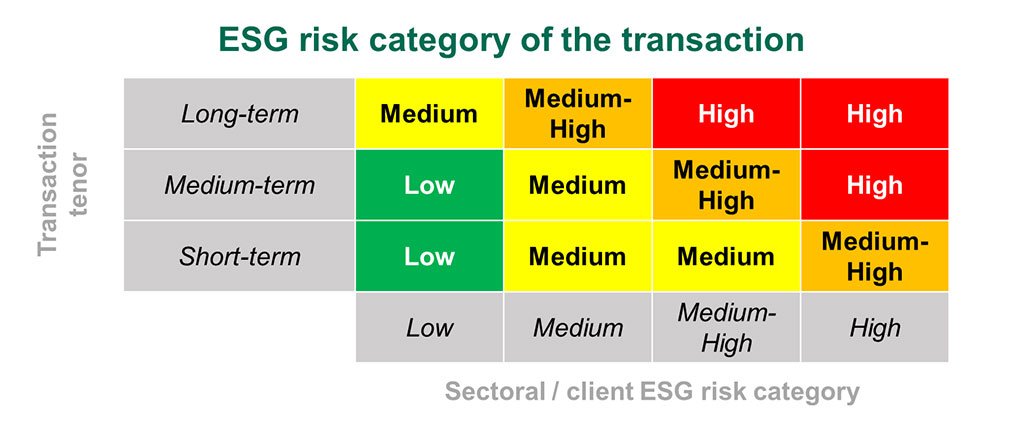
The ESG risk category assigned to a transaction depends on both the client’s ESG risk category (based on its business activity) and the transaction’s residual maturity. Where a transaction exceeds the threshold established by OTP Group and the client is classified as High or Medium-High ESG risk category, an ESG Due Diligence questionnaire is applied as an additional assessment tool. This approach enables a deeper understanding of the factors of potential ESG risks and, where necessary, supports the planning of preventive corrective measures.
As a first step, we screen our clients against OTP Group’s Exclusion List. Activities and practices included on this list are not aligned with OTP Bank’s values and principles. Therefore, we do not enter into financial or any other business relationships with counterparties engaged in activities covered by the Exclusion List.
Accordingly, a zero-tolerance approach to lending is applied to new clients.
At the same time, existing term loans granted to current clients are subject to natural amortisation, while short-term loans may be renewed for a specified period upon the consideration of specific ESG and reputational risks, ensuring a smooth exit from the business relationship.
Our Environmental and Social Exclusion List is available below.
OTP Bank Environmental and Social Exclusion List
Climate Risks Materiality Assessment
To ensure the timely identification of climate-related threats, their effective management, and the Bank’s financial resilience, OTP Bank conducts an annual assessment of the materiality of physical and transition climate risks.
Given that climate risks may materialise through traditional risk categories, we apply the Parent Bank’s methodology to assess the impact of physical and transition risk drivers on credit, operational, market, reputational, liquidity and concentration risks.
In line with the EBA Pillar 3 disclosure requirements and as a member of OTP Group, we also report on clients' physical climate risks at the portfolio level. The Bank identifies material physical climate risks based on the geographical location of key assets, their vulnerability to environmental hazards, as well as the current and expected impact on clients' financial position.

